Milch: A Sharp, 3D Display Font for Handmade Brands
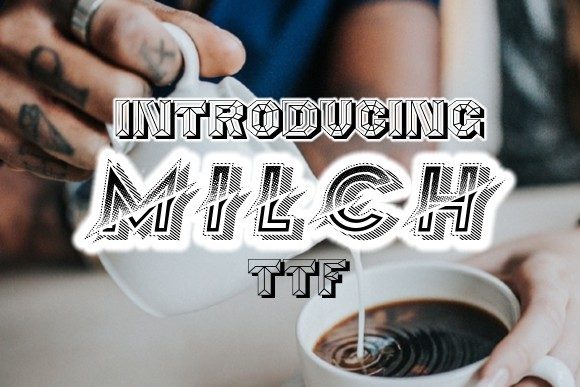
If you’ve ever spent hours tweaking letter spacing on a candle label only to find it looks flat or forgettable—or if your wedding welcome sign reads beautifully on screen but loses its impact when printed and mounted—you know how much hinges on the right display font. That’s why Milch stopped me in my tracks. It’s not just another decorative typeface. It’s a simple, 3D, sharp-looking display font built for makers who need visual punch *and* practical reliability.
Milch has that rare balance: bold enough to command attention at a glance, yet clean enough to feel intentional—not chaotic. Its subtle dimensional effect gives depth without sacrificing clarity, and its sharp, confident lines lend instant sophistication. Think of it as the typography equivalent of a perfectly scored ceramic mug: minimal, modern, and quietly impressive. It doesn’t shout—it *anchors*. That makes it ideal for physical products where first impressions matter most: product tags, boutique packaging, engraved wood signs, vinyl decals, and printed stationery.
I’ve used Milch across real projects—and each time, it elevated the perceived quality. On handmade soap labels, its crisp geometry made ingredients and scent names feel curated, not generic. For a set of printable planner stickers, Milch’s strong letterforms held up beautifully even at 8mm height—no blurring, no jagged edges when cut on my Cricut Maker. And on a farmhouse-style welcome board for a local wedding venue? The slight 3D illusion added texture that translated gorgeously in matte laminate—no extra shadow layers needed.
Where Milch shines brightest is in short, high-impact contexts: brand names, collection titles, seasonal headers (“Spring Collection,” “Holiday Stocking Stuffers”), shop banners, and SVG-based wall art files. It’s not designed for body text or long paragraphs—and that’s by design. As a display font, Milch excels where legibility meets personality: a single word on a tote bag, a monogram on a linen napkin, or “Est. 2023” stamped on a craft fair business card. Its sharpness ensures clean cuts on Silhouette Cameo blades, and its generous x-height keeps small-print labels (like jar tags or gift tag backs) fully readable at 10pt.
For wedding and event creators, Milch brings modern elegance without fuss. I paired it with a delicate script font for “Emma & James” on an invitation suite—and kept Milch alone for the ceremony time and location. The contrast felt intentional, not cluttered. For holiday product lines, I used Milch in all-caps for “Merry & Made” on red-and-kraft gift tags; the 3D effect caught light just enough to add warmth under string lights at markets.
Pairing Milch thoughtfully unlocks even more versatility. Try it with a soft, naturalistic handwritten font for greeting cards—Milch handles the headline (“You’re Invited”), while the script carries the personal note. Or pair it with a clean, neutral sans serif (think Montserrat or Inter) for packaging: Milch for the product name, the sans for ingredients or care instructions. If you’re building a cohesive brand identity, Milch works especially well as your primary display voice alongside a trustworthy serif for fine print—say, Playfair Display for a vintage-inspired bakery line.
Before downloading, check what’s included. Milch comes in standard OTF and TTF formats—fully compatible with Cricut Design Space, Silhouette Studio, Canva, and Adobe apps. While it doesn’t include swashes or alternate characters, its straightforward design means fewer compatibility hiccups across platforms and devices. No ligatures to misfire in mockup previews. No multilingual glyphs to bloat your file size when you’re optimizing for digital downloads. What you get is focused: one expressive, commercially viable display font, ready to drop into your workflow.
Licensing matters—especially when you’re selling physical goods or digital assets. Milch is a commercial font, meaning you can use it freely in your handmade product labels, printable templates, SVG bundles, client branding work, and merchandise like mugs or tees—as long as you’re the licensed user. You don’t need extended licensing for small-batch production or Etsy listings. But remember: you can’t resell Milch itself as a standalone font file, embed it in unsecured web fonts, or distribute it within editable Canva templates where others could extract and reuse it. When in doubt, review the license terms—but for most crafters and small shops, Milch fits cleanly into standard commercial use.
Real talk: Not every font earns repeat use. Milch has. It’s become my go-to for anything needing presence without pretension—whether I’m designing a minimalist candle label for a slow-living brand, mocking up a rustic market banner, or prepping a bundle of printable quote art for digital download. Its sharpness translates consistently across screen, print, and cut material. Its simplicity means less time troubleshooting kerning, more time shipping beautiful things.
If your current display fonts feel either too safe or too busy—if your product tags blend in instead of standing out—if your digital printables lack that tactile, dimensional appeal—Milch might be the quiet upgrade your shop needs. It’s not flashy. It’s focused. And in the world of handmade goods, where authenticity and intentionality sell, that kind of quiet confidence is everything.